
A fire door inspection can uncover problems that look minor in everyday use but become critical once a fire starts. A damaged seal, unsuitable letter plate, excessive gap or incorrect glazing system might not stop a door opening and closing, but that does not mean it will perform as intended under fire conditions.
Two highlighted fire door inspection and testing videos make this especially clear: VICAIMA’s BWF-Certifire fire test and Lorient’s comparative fire door test. Both show how correct components and installation affect performance under extreme heat.
Quick Summary
- Fire doors are complete fire-resisting systems, not simply heavier doors.
- Fire door inspections look at the door, frame, glazing, seals, gaps, hardware and closing action.
- Fire door testing shows why apparently small defects can seriously reduce performance.
- Fire door checks form part of wider duties under current fire safety legislation.
Fire doors themselves form an important part of a building’s passive fire protection.
What Does Fire Door Testing Actually Show?
Formal fire door inspection and testing is different from an inspection of an installed door. Testing places a representative doorset under controlled furnace conditions to assess its performance. Meanwhile, an on-site inspection is non-destructive and looks for defects that could stop an installed door performing as intended.
The VICAIMA BWF-Certifire Test
In the VICAIMA film, three nominally 30-minute fire doors are tested with different components and installation details.
One door uses toughened safety glass instead of suitable fire-rated glazing. Its glass fails after roughly four minutes. Another, representing a typical flat entrance door, has an ordinary letter plate and no intumescent seals between the door and frame. The letter plate fails only a few minutes into the test, while smoke and heat increasingly escape around the door.
The correctly specified and installed door continues resisting the fire beyond 30 minutes, finally giving way at around 33 minutes.
That is why an inspection should assess the complete assembly, not simply confirm that a fire door is present.
Why Fire Door Sealing Matters
The Lorient comparative test isolates the effect of fire and smoke seals for doors. Two otherwise identical doors are tested, one unsealed and one fitted with the correctly specified sealing system.
Smoke leakage becomes visible around the unsealed door early in the test. As temperatures rise, that assembly deteriorates and the glazed panel eventually collapses. The sealed door maintains its required fire integrity beyond the 30-minute period.
What Intumescent and Smoke Seals Do
Intumescent strips expand when exposed to heat, helping close gaps between the door and frame. Smoke seals then restrict smoke passing through those gaps earlier during a fire.
Why Small Defects Matter
The Lorient test shows why missing, damaged, painted-over or incorrectly specified seals should not be dismissed as cosmetic defects.
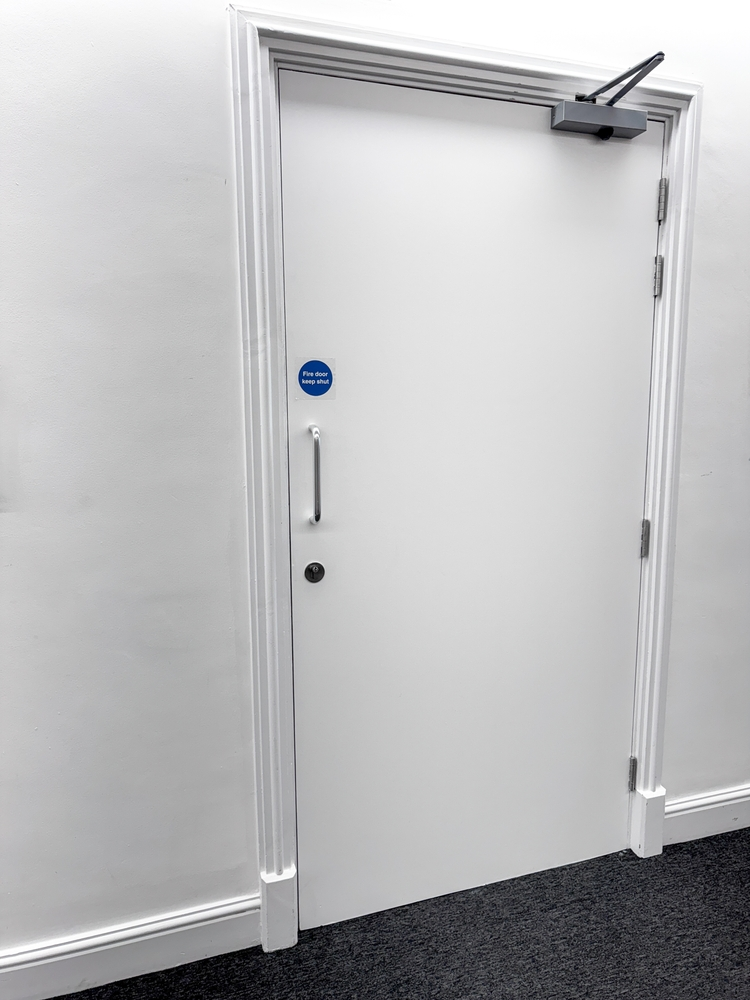
What Is Checked During a Fire Door Inspection?
The scope depends on the building, door and fire risk assessment, but common checks include:
- Checking the door and frame for damage, warping or unsuitable alterations.
- Measuring and assessing gaps around the door.
- Inspecting intumescent strips and smoke seals.
- Checking fire-resisting glazing and its glazing system.
- Inspecting hinges, locks, letter plates, viewers and other ironmongery.
- Testing whether the self-closing device closes the door fully.
| Area | What Can Go Wrong | Why It Matters |
| Fire door sealing | Missing or damaged seals | Fire or smoke may pass around the door |
| Glazing | Incorrect glass or glazing system | The opening may fail prematurely |
| Letter plates | Unsuitable components | They can create a route for fire and smoke |
| Door gaps | Excessive gaps | The intended barrier can be compromised |
| Self-closer | Door does not fully close | The door cannot perform properly |
What Do the Fire Safety Regulations Require?
The Regulatory Reform (Fire Safety) Order 2005 places duties on the responsible person to carry out and review a suitable fire risk inspection and assessment and maintain appropriate fire precautions.
In addition, the Fire Safety (England) Regulations 2022 add specific legal requirements for multi-occupied residential buildings. Where the top storey is more than 11 metres above ground level, responsible persons must use best endeavours to check flat entrance fire doors at least every 12 months and check communal fire doors at least every three months.
The government’s current fire door inspection guidance also explains what should be considered during these routine checks, which is where we here at Metrix come in. Whilst government guidance says that whilst these Regulation 10 checks are intended to be ‘simple visual checks’ – any repair or replacement identified should be carried out by a competent contractor.
Most people find that hitting two birds with one stone saves multiple call-outs and undue stress, as we are able to thoroughly inspect the fire safety of doors, as well as being able to repair and advise on any necessary replacements as well.
Fire Door Inspection Is More Than a Checklist
Both of these videos make the same wider point: a fire door can look normal and still contain defects that dramatically change how it behaves in a fire.
A proper fire door inspection helps identify those defects, record their condition and establish what action is required. For responsible persons, managing agents and building owners, that information supports maintenance planning and the wider fire risk assessment.
Metrix Contractors and our sister company, MF Fire Door Inspections Ltd., carry out fire door surveys and fire door inspections to help identify issues before they become a real-world risk. To discuss fire door inspections for your building, call 01323 487134 or visit https://www.metrixcontractors.co.uk/.
If you liked this, you may also like: Flat Fire Door Regulations: Why Does Your Front Door Need a Survey?
Frequently Asked Questions About Fire Door Inspection
How often should a fire door inspection be carried out?
How often a fire door should be inspected depends on the building, its use and the applicable fire safety requirements. In residential buildings in England with a top storey over 11 metres, communal fire doors must be checked at least every three months and flat entrance doors at least annually.
What is the difference between fire door inspection and fire door testing?
A fire door inspection is normally a non-destructive assessment of an installed door, including its condition, gaps, seals, hardware and closing action. Fire door testing usually refers to controlled testing of a doorset or its components to establish how it performs when exposed to fire.
Can a fire door fail even if it looks undamaged?
Yes. A fire door can appear perfectly serviceable while having unsuitable glazing, missing seals, excessive gaps, incorrect ironmongery or problems with its frame. These details may affect how well the complete doorset contains fire and smoke.
What gaps are acceptable around a fire door?
There is no single gap measurement that should simply be applied to every fire door, as the correct dimensions depend on the particular doorset and its certification or manufacturer instructions. Inspectors will assess whether the gaps are appropriate and whether they could compromise the door’s intended performance.
Do fire doors need intumescent strips and smoke seals?
Many fire doors require intumescent seals, smoke seals or a combined sealing system, depending on their specification and location. Intumescent material expands when exposed to heat, while smoke seals are intended to restrict smoke passing through the gaps around a closed door.
Can you paint over fire door seals?
Painting some types of fire door seals may affect their performance, particularly if several layers build up or the seal becomes damaged or obstructed. The safest approach is to follow the manufacturer’s instructions and replace any seal where its condition or suitability is uncertain.
Does a fire door have to close by itself?
Where a fire door requires a self-closing device, it should be capable of closing fully into the frame from an open position. A door that stops short because of a weak closer, damaged hinges, flooring or another obstruction may not provide the protection it was designed to offer.
Who is responsible for checking fire doors in a block of flats?
The legal duties generally sit with the building’s Responsible Person, which could be an owner, landlord, managing organisation or another party with control over the premises. Current fire safety legislation also requires flat entrance doors leading onto common parts to be considered within relevant fire risk assessments.
What happens if a fire door fails an inspection?
A failed inspection does not necessarily mean the entire door must immediately be replaced. Some defects can be repaired or corrected, while more serious problems may require replacement components or a complete new doorset. The appropriate action depends on the defect and the evidence available for the existing door.
Can a normal door be upgraded into a fire door?
Sometimes an existing door can be upgraded, but adding seals, a closer or fire-rated hardware does not automatically turn an ordinary door into a compliant fire door. The complete assembly needs to provide the required level of fire resistance, so any proposed upgrade should be properly assessed rather than relying on individual components alone.